|
Building the Miniature
Film Sets of Dollhouse Murders
Brooklyn-based set designer and miniature
artist Christina O'Neil brings her love of handcrafted miniature
worlds to the screen in an independent psychological thriller
about art, power, and creative control.
I've spent the last decade
working as a set designer in film and commercial production,
and the past several years specializing in miniature art. My
work often involves creating highly stylized environments, whether
it's a full-scale set for a commercial, a fashion editorial,
or an intricately detailed room at 1:12 scale. I'm inspired by
magical realism and love finding the intersection where fantasy
meets sincere storytelling.
My journey into miniatures
began as a largely self-taught artist, learning through online
tutorials and experimenting with woodworking, sculpting, painting,
and textiles. I was initially drawn to miniatures as an accessible
and affordable way to create entire worlds of my own imagination.
After discovering the International Guild of Miniature Artisans
(IGMA), I began studying museum-quality miniature techniques
with professional artisans and found a wonderful community dedicated
to preserving and advancing this extraordinary craft. I'm also
excited to have recently joined the Miniature Art Society of
Florida (MASF)!
Now, I'm bringing my love
of miniature making and filmmaking together with Dollhouse Murders,
a psychological thriller short film that I'm writing, directing,
producing, and creating original miniature artwork for.
The Story
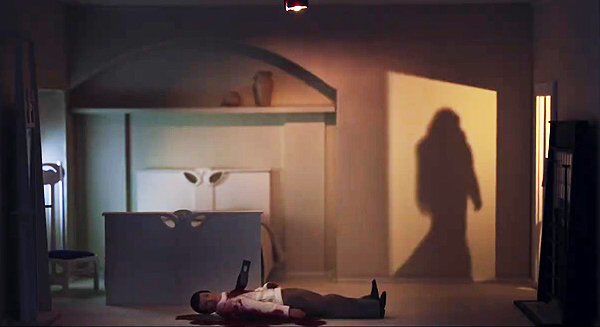
Dollhouse Murders follows Naomi, a struggling miniature artist
whose wealthy patron finances her new studio and increasingly
disturbing artwork: elaborate dollhouse crime scenes depicting
murdered men. When he offers her $20,000 to create a miniature
depicting his ex-wife's murder, their relationship spirals into
a struggle over money, intimacy, and creative control.
The film begins as a dark comedy
before gradually descending into psychological horror. At its
center is a question that has long fascinated me as an artist:
Who ultimately controls a work of art, the person who creates
it, the person who finances it, or the person who consumes it?
Rather than offering clean revenge
or catharsis, the film explores the quieter horror of containment:
what it means to be aestheticized, consumed, and ultimately transformed
from a subject into an object. Naomi's work begins as artistic
rebellion, but gradually becomes a spectacle that is visually
stunning, marketable, and dangerous. Each miniature crime scene
becomes both an independent artwork and a psychological portrait,
reflecting Naomi's imagination, frustrations, and increasingly
complicated relationship with her patron.
At its core, Dollhouse Murders
is a Faustian bargain about creative autonomy, coercive intimacy,
and the compromises artists make to survive.
https://artcubenation.com/cube-news/miniature-film-sets-dollhouse-murders/
Building the Miniature Crime
Scenes
One of the most exciting parts
of this project is that the miniature artwork is not just set
dressing. The dioramas are essential to the film's visual language
and narrative, functioning as both extensions of the main character's
psyche and independent characters in their own right. The film
features three elaborate miniature interiors, each representing
a different period and design aesthetic: a colorful, cross-stitched
1950s nursery, a gaudy 1980s green-tiled bathroom, and an ornate
Art Nouveau-inspired bedroom.
Each miniature is constructed
using a combination of woodworking, sculpting, painting, textiles,
and traditional dollhouse-making techniques. We're filming the
dioramas from multiple perspectives. For me, miniature making
is an intersection of technical precision and artistic imagination.
While I appreciate the extraordinary craftsmanship required to
reproduce reality at a reduced scale, I'm equally interested
in how miniatures can distort, exaggerate, and reinterpret the
familiar. As the characters examine each piece, we'll use specialized
macro photography lenses to enter the miniature environments,
bringing their haunting details to life and allowing these tiny
worlds to look back at the characters themselves. Miniatures
invite us to become voyeurs. We can look into private spaces,
examine every object, and observe an entire world from a position
of complete control. Dollhouse Murders uses that perspective
to question the pleasure we take in looking, particularly when
the subject is violence at the expense of real people. For me,
the challenge is to make these miniature environments feel like
fully realized artworks with their own presence and agency, while
allowing them to carry the emotional weight of the story.
|